


Battery Levels and the Relationship Triangle
All of my writing is free. I write because it allows me to better understand my own points of view, I thoroughly enjoy it and I believe that knowledge gets to be accessible, not locked behind a pay wall. Yet, creating deep, quality content takes time, energy, and a herculean effort from this adhd brain. In the spirit of reciprocity, if something here lands for you, consider buying me a coffee to support this work 🙏🏾
A Capacity-Based Approach to Neurodivergent Relationships
If relationships feel harder than they should, there’s a good chance it isn’t a communication issue.
It may be a capacity issue.
Over the past few months, many of my clients have come into sessions carrying the same quiet confusion. Connection feels fragile. Small moments escalate quickly. Love starts to feel like work. I just want some alone time damnit!
The common thread is not a lack of care. It’s exhaustion.
For neurodivergent individuals and couples especially, relationships often strain not because of conflict, but because energy goes unnamed. When capacity is invisible, silence gets misread, withdrawal feels personal, and shutdown turns into a story about rejection.
Two frameworks have consistently helped bring clarity and relief to these dynamics: the idea of battery levels in relationships and the relationship triangle.
Together, they offer a grounded, nervous-system-aware way to understand intimacy.
Why Relationships Feel Hard When Capacity Goes Unnamed
Most of us were taught that relationships fail because people are bad communicators or emotionally unavailable.
What we were not taught is how much connection depends on nervous system capacity.
When someone is depleted, their ability to engage, process, and connect drops.
If that depletion is not named, partners fill in the blanks with meaning, and that meaning usually hurts.
Silence becomes disinterest.
Needing space becomes distance.
Not wanting to talk becomes lack of care.
This is especially common in neurodivergent relationships, where shutdown or withdrawal is often a sign of nervous system overload rather than emotional disengagement.
Want a little more on this? Check my episode on when I thought we’d break up during our honeymoon
The Battery Level Framework: Understanding Energy in Relationships
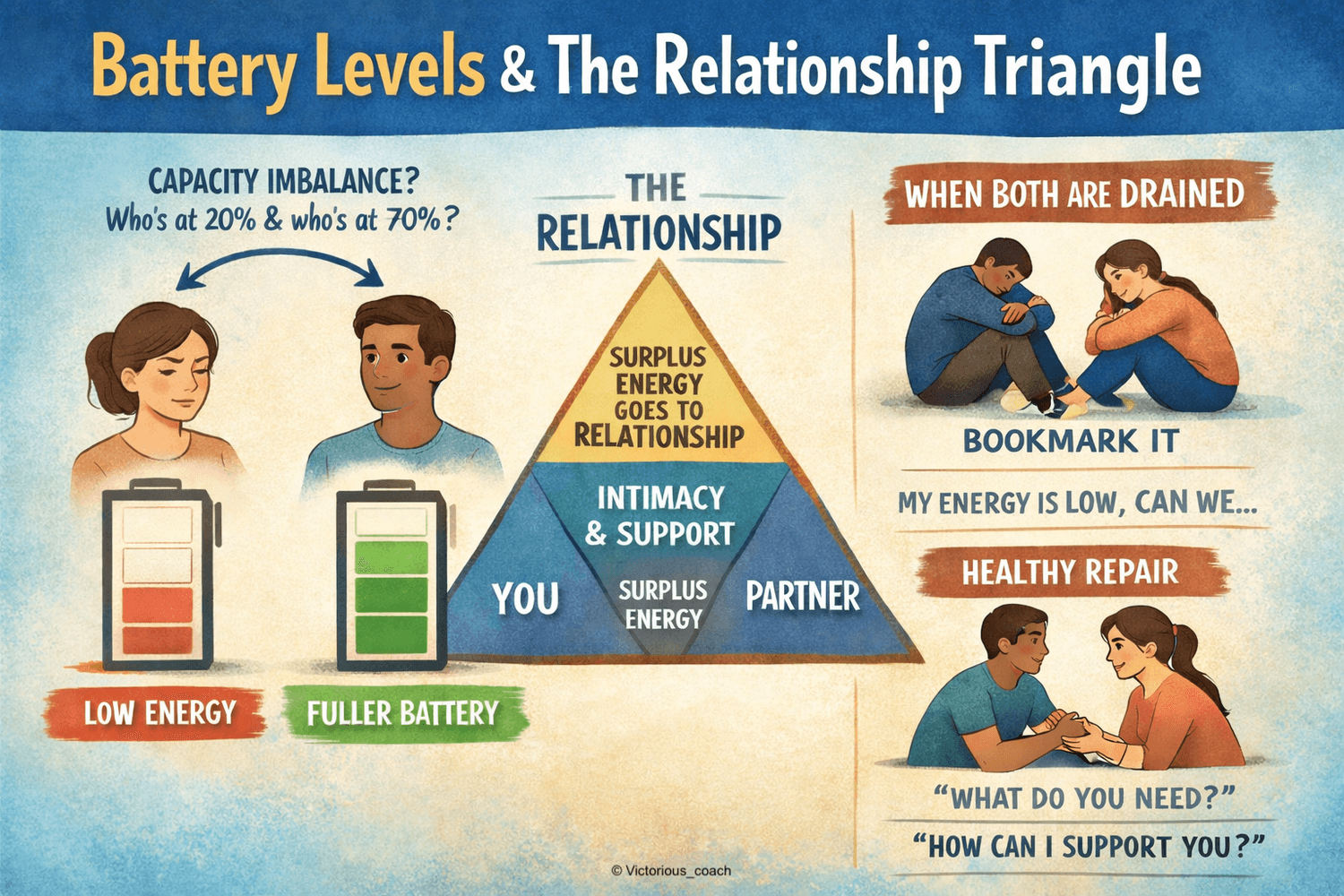
Imagine that every person in a relationship has a battery percentage at any given moment.
Some days you wake up at 80 percent.
Some days you are at 40 by noon.
Some days you are running on fumes and doing your best to hold it together.
This is not a mindset problem. It is a physiological reality.
Work, caregiving, executive functioning, sensory input, masking, and emotional labor all draw from the same system. When capacity is not named, it is misinterpreted.
Battery language externalizes the experience.
Instead of saying, You do not want to connect with me, it becomes, I am at 30 percent and do not have conversational capacity right now. I’d like some solo time until dinner.
That shift alone removes a tremendous amount of unnecessary conflict!!!! Can you feel your own shoulders drop?
When One Partner Has More Energy Than the Other
Let’s say one partner comes home at 30 percent after a long day of work, caregiving, and decision fatigue.
The other partner is at 60 percent.
In battery-aware relationships, the partner with more capacity leads with surplus.
That surplus might look like:
Taking on more household tasks.
Offering care without resentment.
Giving space without taking it personally.
Not asking for emotional processing that is not available.
This is informed compassion.
Capacity fluctuates. Relationships that acknowledge this remain flexible instead of brittle.
What to Do When Both Partners Are Low on Energy
This is the scenario most people are USUALLY never taught how to navigate.
One partner is at 20 percent.
The other is at 15 percent.
Old relationship narratives suggest someone should push through, fix the issue, or be the strong one. That expectation often creates mayhem.
When both partners are depleted, the relationship itself needs to enter energy conservation mode.
This is not the time for big conversations, emotional processing, or repair attempts.
It is the time for minimum viable connection.
That might mean eating something simple near each other, sitting together doing individual hobbies without talking, pausing a conversation to play with kiddos or pets, or choosing that acupuncture over resolution.
Saying, We are both fried, let’s come back to this later, is not avoidance. It is wild emotional maturity between people.
When One Partner Is Chronically Low Capacity
This is where honesty becomes essential.
Relationships can hold temporary imbalance. Illness, burnout, life transitions, and mental health seasons all affect capacity.
What relationships struggle to survive is chronic imbalance without conversation.
When one partner is consistently running at 20 or 30 percent and the other is regularly compensating, resentment grows quietly. Love begins to feel like obligation.
Battery awareness does not magically fix this, but it makes it visible.
The higher-capacity partner is allowed to say, I care about you, and I am noticing that I am often carrying the relationship.
This is not blame. It is information.
The Relationship Triangle: Separating the Individuals From the Relationship
Picture a triangle.
One partner is one bottom corner.
The other partner is the other bottom corner.
The top point is the relationship itself.
The relationship is not one person sacrificing themselves for the other. It is not two people fused together. It is not something one partner props up alone.
Each person is responsible for tending their own corner. Their regulation, capacity, healing, and support systems.
The relationship receives surplus.
Not guilt.
Not obligation.
Not martyrdom.
When one partner is frequently depleted, the question becomes what support is needed to rebuild capacity, what is within that person’s control, and what the relationship can realistically hold.
Sometimes this leads to practical changes.
Sometimes it leads to difficult truths about sustainability.
Repair After a Capacity Mismatch
Even in the healthiest relationships, capacity mismatches happen!
Healthy is also culturally subjective, but alas;
Someone pushes for connection when the other needs space.
Someone shuts down without explaining.
Someone asks for more than is available.
Someone busts in the door immediately with an emotional vent session.
Repair is not about proving who was right. It is about restoring safety.
In capacity-based relationships, repair happens after regulation, not during dysregulation.
That means waiting until both partners are resourced enough to stay present.
Repair might sound like:
I did not have the capacity and I can see how that felt abrupt.
I pushed because I was anxious, not because you failed.
I thought I had more to give than I actually did.
Repair also includes renegotiation. What could we do differently next time? How can low capacity be signaled earlier? What support is needed outside the relationship? What can you do to restore yourself?
Healthy repair creates clarity, not shame.
[Struggle with hard conversations? I got you. Check this blog or this episode]
Intimacy Built on Capacity, Not Obligation
Needing space is not abandonment.
Low capacity is not a moral failure.
Protecting energy is not selfish.
And it is also not fair to ask a relationship to survive indefinitely on one person’s surplus.
Healthy relationships are built when both partners actively tend their own capacity so that giving to the relationship is a choice, not a survival strategy.
Two individuals.
Two nervous systems.
Two batteries.
One relationship that receives what is genuinely available.
That is not cold. It is honest.
Honesty is what makes relationships resilient instead of quietly resentful.
A Gentle Note on Support
If this brought something up for you, you are not behind nor broken.
These patterns are rarely about effort.
They are about nervous systems doing their best without the right frameworks.
Not to mention, most of us were never taught how to relate firmly, compassionately or effectively. If you were, truly hats off to whomever raised you!!
This is the kind of work I do slowly and relationally in 1:1 coaching, building capacity from the inside out and untangling relational dynamics without blame or pressure. That support is there if and when it feels right.
P.S. If you're wondering about me - I hold a PCC coaching credential, breathwork facilitation certification, trauma sensitive somatic training, adhd certification, ongoing supervision, and about a decade of my own therapeutic and somatic work.
I'm also neurodivergent as hell, which informs everything about how I work. None of that makes me the right coach for you, but it hopefully gives you a sense of how I come to this work.
I may receive a commission for links shared in a blog, podcast, or newsletter. You don’t have to use these links, yet I’d be grateful if you chose to! Thanks again for your support, I hope you find the content supportive, insightful, and helpful!
P.S. If you're wondering about me - I hold a PCC coaching credential, breathwork facilitation certification, trauma sensitive somatic training, adhd certification, ongoing supervision, and about a decade of my own therapeutic and somatic work.
I'm also neurodivergent as hell, which informs everything about how I work. None of that makes me the right coach for you, but it hopefully gives you a sense of how I come to this work.
I may receive a commission for links shared in a blog, podcast, or newsletter. You don’t have to use these links, yet I’d be grateful if you chose to! Thanks again for your support, I hope you find the content supportive, insightful, and helpful!
Comments
Recent Posts
See All

T&C || Privacy Policy || Home || Quiz
Supporting the neurodiverse in remembering who TF they are through coaching, breathwork & facilitation.


©2026 adventuresOFcommunity DBA victorious coach
Adventurously based in Denver, CO