


How to Rebuild Self-Trust as a Late-Diagnosed ADHD Woman
All of my writing is free. I write because it allows me to better understand my own points of view, I thoroughly enjoy it and I believe that knowledge gets to be accessible, not locked behind a pay wall. Yet, creating deep, quality content takes time, energy, and a herculean effort from this adhd brain. In the spirit of reciprocity, if something here lands for you, consider buying me a coffee to support this work 🙏🏾
Let's get something out of the way first.
Self-trust and confidence are not the same thing. They get collapsed into each other constantly, and if you've been operating like they're interchangeable, that might be part of why rebuilding one of them feels so impossible.
Confidence is performance-adjacent. It's the energy you bring into a room, the ability to hold a presentation together, the surface-level certainty you can project even when you're running on fumes. A lot of late-diagnosed ADHD women have plenty of confidence. We've had to! We've been compensating and masking and hustling our way into rooms for years.
Self-trust is something quieter and more foundational. It's the belief that your own internal signals are worth listening to. That when your gut says something, it counts as data, not noise. That you don't need to run every instinct by three other people before you act on it.
You CAN be both deeply confident and have almost zero self-trust.
Why Self-Trust Erodes in Late-Diagnosed ADHD Women Specifically
This isn't random. There's a very particular erosion pattern that happens when you grow up with ADHD that goes unrecognized, and it tends to follow a predictable sequence.
First, your perception gets labeled unreliable. Too emotional. Too sensitive. Overreacting. Forgetting things. Misreading situations. The feedback, whether from teachers, family, or peers, was consistent: your read on things is off.
Second, because ADHD also affects interoception, your brain's ability to access internal signals in real time, you sometimes genuinely couldn't retrieve what you were feeling quickly enough to defend it. So the criticism landed without rebuttal. And you started to believe it.
Third, you outsourced. You started looking to other people to tell you what was true, what was appropriate, what the right call was. Not because you were weak. Because it was logical. Your environment kept confirming that your judgment was flawed, so you stopped relying on it.
That outsourcing starts as a smart survival adaptation. But over time, it becomes the default setting. And the longer it runs, the more it costs you. That cost is self-trust. And it shows up as perfectionism, external validation seeking, people-pleasing, masks you build so carefully you forget they're masks.
It's the foundational crack underneath almost everything my clients come to me for. They usually don't name it that right away. They think they're coming in for productivity, or time management, or relationship woes. They figure out pretty quickly it runs deeper than that.
Why Affirmations Won't Fix This
When self-trust has eroded this way, affirmations don't work. Not because they're useless in every context, but because you cannot affirmation your way past a nervous system that has years of evidence pointing in the opposite direction.
Saying I trust myself in the mirror when your whole internal history says otherwise doesn't build trust. It builds dissonance. Your system rejects it.
You have to start with evidence. Small, concrete, unglamorous evidence. You build a case for yourself the same way you'd build one for anyone else.
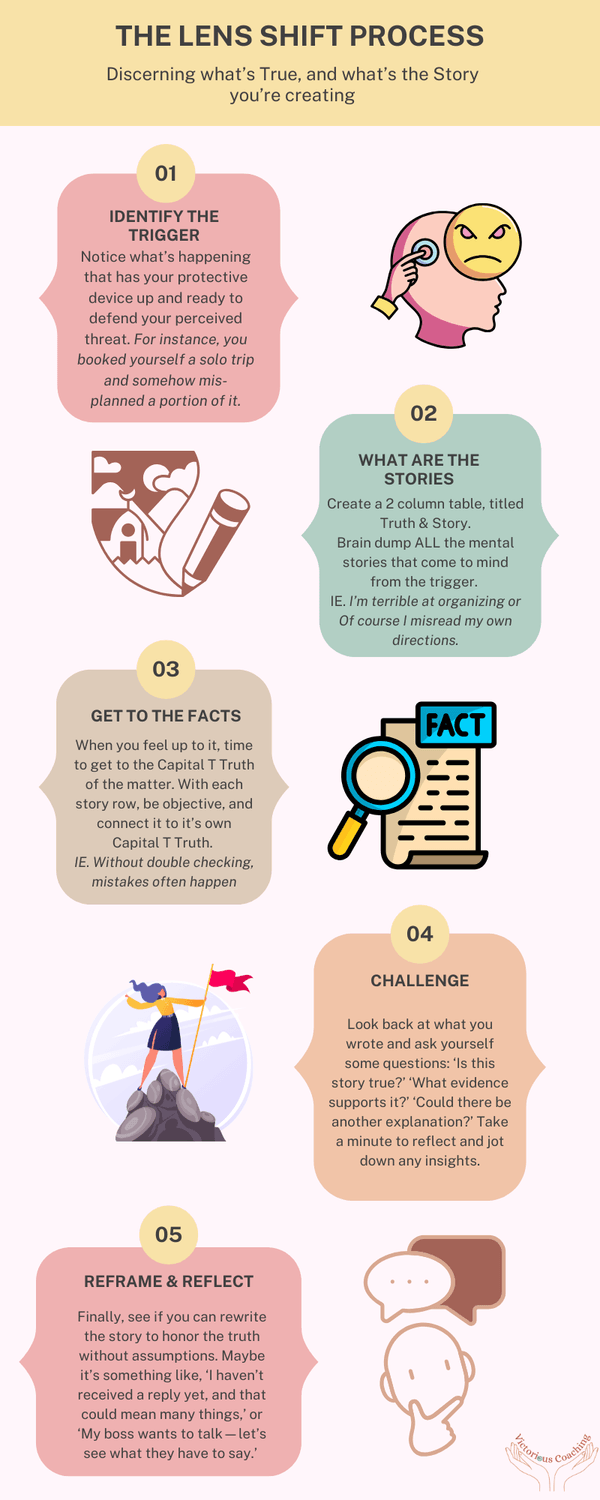
One of the most consistently useful tools I work with, and use myself, is something I call the Story versus Truth exercise. It's available in full right here; I think it's one of the most practical things you can do when your inner critic is particularly loud.
This Is a Practice, Not a Moment
While you're working through this, notice what's happening in your body. Shoulders up? Tightness in your chest? Foot moving? That activation is not a sign you're doing it wrong. It means the work is landing somewhere real.
If you need to regulate alongside this process, crying is valid. Movement is valid. EFT tapping, earthing, music. Whatever helps your nervous system stay present without shutting down.
The goal isn't to think your way out of the story. It's to feel it, name it, and start replacing it with something more accurate.
Self-trust doesn't rebuild in one exercise. There will be moments where the story is so loud and so familiar that the truth feels thin by comparison. That's not failure. That's just the work.
The fact that you're here, building the framework, choosing to look at this stuff at all, that's evidence too. Put it in the truth column.
Walk through it with something real, even something small, and notice what shifts.
P.S. If you're wondering about me - I hold a PCC coaching credential, breathwork facilitation certification, trauma sensitive somatic training, adhd certification, ongoing supervision, and about a decade of my own therapeutic and somatic work.
I'm also neurodivergent as hell, which informs everything about how I work. None of that makes me the right coach for you, but it hopefully gives you a sense of how I come to this work.
I may receive a commission for links shared in a blog, podcast, or newsletter. You don’t have to use these links, yet I’d be grateful if you chose to! Thanks again for your support, I hope you find the content supportive, insightful, and helpful!
Get on the newsletter 👇🏾
Take me to
Comments
Recent Posts
See All

T&C || Privacy Policy || Home || Quiz
Supporting women reclaim authorship of their lives by moving beyond labels, expectations, and inherited stories so they can live with greater agency, rhythm, and freedom


©2026 adventuresOFcommunity DBA Victorious Coaching
Adventurously based in Denver, CO