

Success Amnesia
All of my writing is free. I write because it allows me to better understand my own points of view, I thoroughly enjoy it and I believe that knowledge gets to be accessible, not locked behind a pay wall. Yet, creating deep, quality content takes time, energy, and a herculean effort from this adhd brain. In the spirit of reciprocity, if something here lands for you, consider buying me a coffee to support this work 🙏🏾
Why ADHD Women Erase Their Wins & How to Stop
You finished a huge project last week. Nailed that presentation. Got praised by your boss. And for about 47 seconds, you felt glorious about it!!
Then your brain immediately went:
okay but what's next? What did I forget? What am I behind on?
That forlorn accomplishment of 2 minutes ago? Already erased. Gone. Like it never happened.
If you're a late-diagnosed ADHD woman, this could be your daily experience. And it has a name: success amnesia.
What is Success Amnesia?
Success amnesia is when your brain erases your accomplishments the second they happen.
You don't hold onto wins. You don't internalize evidence that you're capable. You don't build a reservoir of proof that you're actually doing okay.
Instead, you start from zero every single day. Proving yourself over and over. Never getting credit for what you've already done.
This isn't occasional forgetfulness. For late-diagnosed ADHD women, this is constant.
You get the promotion but immediately focus on how you're going to mess it up.
You finish the project but can only see the parts that weren't perfect.
You receive genuine praise and your brain dismisses it as people being nice or not knowing the real you.
Nothing sticks. Nothing accumulates. You're perpetually starting from scratch.
Watch the Full Episode
I break down success amnesia and these three rewiring practices in detail in this podcast episode #59.
Why ADHD Brains Erase Accomplishments
Success amnesia isn't about low self-esteem or negative thinking. This is neurological. This is how ADHD brains are wired.
1. Working Memory Challenges
ADHD brains have challenges with working memory: the part of your brain that holds information temporarily and helps you recall what just happened.
When you accomplish something, neurotypical brains naturally encode that as a positive memory. It gets stored. It becomes part of their repertoire of evidence that they're competent, capable, etc.
But ADHD brains don't do this as efficiently. The accomplishment happens, then your brain immediately dumps it to make room for the next thing. It doesn't stick around long enough to become internalized evidence.
Think of it like trying to hold water in your hands. Neurotypical brains have a cup. ADHD brains have a colander. The water goes right on through.
2. Amplified Negativity Bias
All human brains have a negativity bias. We're wired to remember threats more than rewards because evolutionarily, that kept us alive. Awareness, vigilance, intuition - these are primordial.
But research shows that ADHD brains have an even stronger negativity bias 🙃. We're more attuned to what went wrong than what went right. We scan for problems, for mistakes, for things we need to fix.
Which means that even when something goes well, your brain is more likely to zoom in on the one tiny thing that didn't go perfectly than on the 47 things that did.
3. Masking and Compensation
If you're late-diagnosed, you spent decades compensating for a brain difference you didn't even know you had.
You worked twice as hard to get the same results as everyone else. You developed elaborate systems to keep yourself organized. You white-knuckled your way through tasks that felt impossible. Trust me, I know these all too well.
And when you succeeded, you didn't think I'm capable. You thought I barely pulled that off or I got lucky or If they knew how hard that was for me, they'd know I'm a fraud.
Success didn't feel like evidence of your capability. It felt like evidence that you'd successfully hidden your struggle. Again.
So your brain learned not to celebrate wins. It learned to stay vigilant. To keep scanning for the next threat. To never let your guard down.
4. Trauma and Survival Mode
Many late-diagnosed ADHD women have experienced some form of trauma. Relational trauma from being told you're too much or not enough. Academic trauma from constantly being compared to neurotypical peers. Medical trauma from being dismissed or misdiagnosed for years. And the litany of additional big and little T traumas we all know very well.
When your nervous system is in survival mode, it doesn't have the capacity to celebrate. It's focused on threat detection.
Wins don't register as wins. They register as temporary relief before the next threat.
Your nervous system literally can't hold onto success when it's too busy scanning for danger.
Why Success Amnesia Matters
Success amnesia isn't just annoying. It's destructive in specific ways:
It erodes self-trust. When you can't remember your own wins, you can't build evidence that you're capable of handling things. Every new challenge feels like starting from scratch. You don't trust yourself because you genuinely can't recall the last 47 times you figured it out.
It fuels imposter syndrome. You feel like a fraud because your brain literally erases the evidence that you're not. You accomplished the thing, but your brain won't let you claim it. So you walk around feeling like you're one mistake away from being exposed, even when objectively you're doing well.
It makes burnout inevitable. If nothing you do ever counts, you never get to rest. You're always behind. Always proving yourself. Always starting from zero. That's not sustainable. That's a straight path to burnout.
It keeps you dependent on external validation. When you can't internalize your own wins, you become dependent on other people telling you you're doing okay. But even when they do, your brain dismisses it. So you're stuck in this cycle of seeking validation that never actually lands.
It robs you of joy. You deserve to feel good about what you accomplish. You deserve to pause and acknowledge your effort. You deserve to let your wins actually register. Success amnesia steals that from you.
How to Rewire Success Amnesia: 3 Practices That Work
You can rewire success amnesia! Not by trying harder to remember, but by working with how your brain actually functions.
Here are 3 suggested practices that you might find supportive -
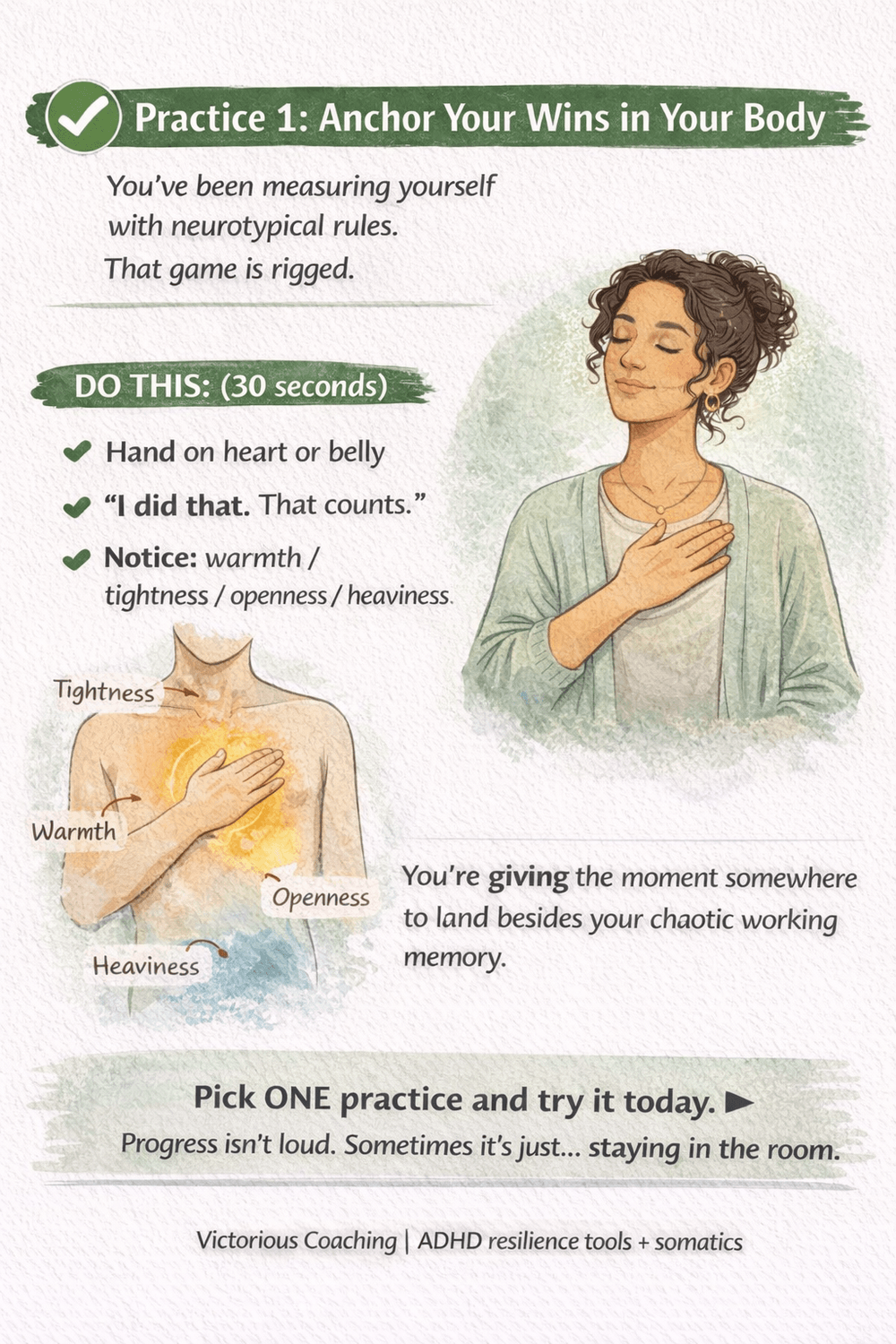
Practice 1: Anchor Your Wins in Your Body
Your brain might erase the accomplishment, but your body can hold it if you let it.
Here's how:
The next time you complete something, finish something, accomplish something, don't just move on to the next thing. Pause. Literally stop what you're doing.
Put your hand on your heart or your belly. Feel your body. Notice what's there.
Then say out loud: I did that. That counts.
You don't have to believe it. You don't have to feel good about it. Just state the fact.
Then notice what sensations are in your body. Warmth? Tightness? Openness? Heaviness?
You're not trying to feel a certain way. You're just anchoring the moment in your body so it has somewhere to land besides your unreliable working memory.
Do this for 30 seconds. That's it.
Your body remembers what your brain forgets.
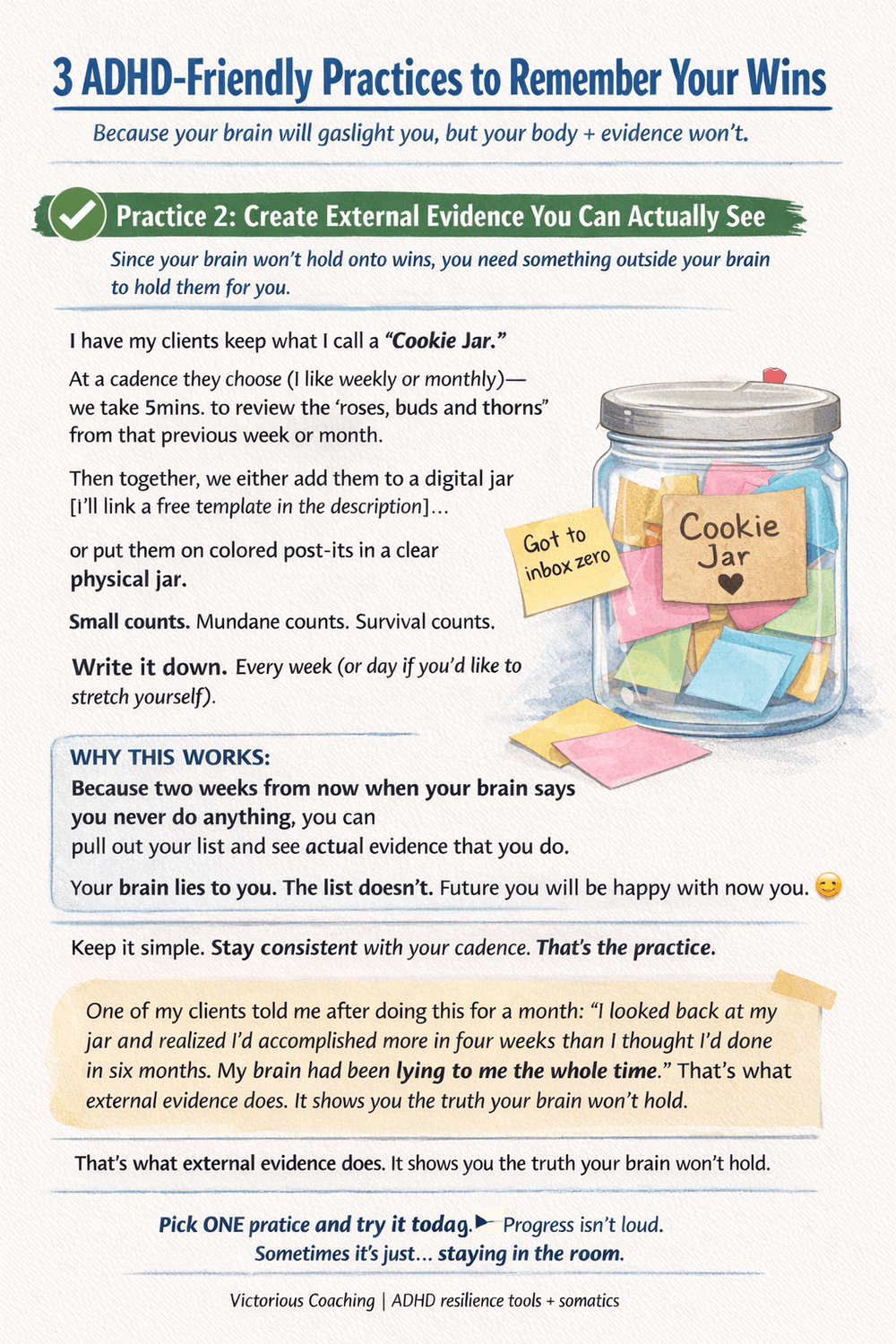
Since your brain won't hold onto wins, you need something outside your brain to hold them for you.
I have my clients keep what I call a Cookie Jar.
At a cadence they choose, I like weekly or monthly - then take 5mins. to review the ‘roses buds and thorns’ from that previous week or month.
Then, I place them into my digital cookie jar or maybe it’s a clear jar in your environment that you can add physical colored post its to!
They don't have to be earth shatteringly big.
Got to inbox zero.
Made lunch.
Didn't spiral when that thing happened.
Small counts. Mundane counts. Survival counts.
Write it down. Every day if you’d like to stretch yourself .
Why? Because two weeks from now when your brain is telling you you never get anything done, you can pull out / empty that list and see actual evidence that you do.
Your brain lies to you. The list doesn't. Future you will be happy with now you :)
Keep it simple. Stay consistent with your chosen cadence. That's the practice.
One of my clients told me after doing this for a month: I looked back at my jar and realized I'd accomplished more in four weeks than I thought I'd done in six months. My brain had been lying to me the whole time.
That's what external evidence does. It shows you the truth your brain won't hold.
This is the big one. The one that changes everything if you let it.
You've been measuring success by neurotypical standards your entire life. By productivity. By output. By how much you got done.
But for ADHD brains, that's a rigged game. You're never going to win by those rules.
So change the rules.
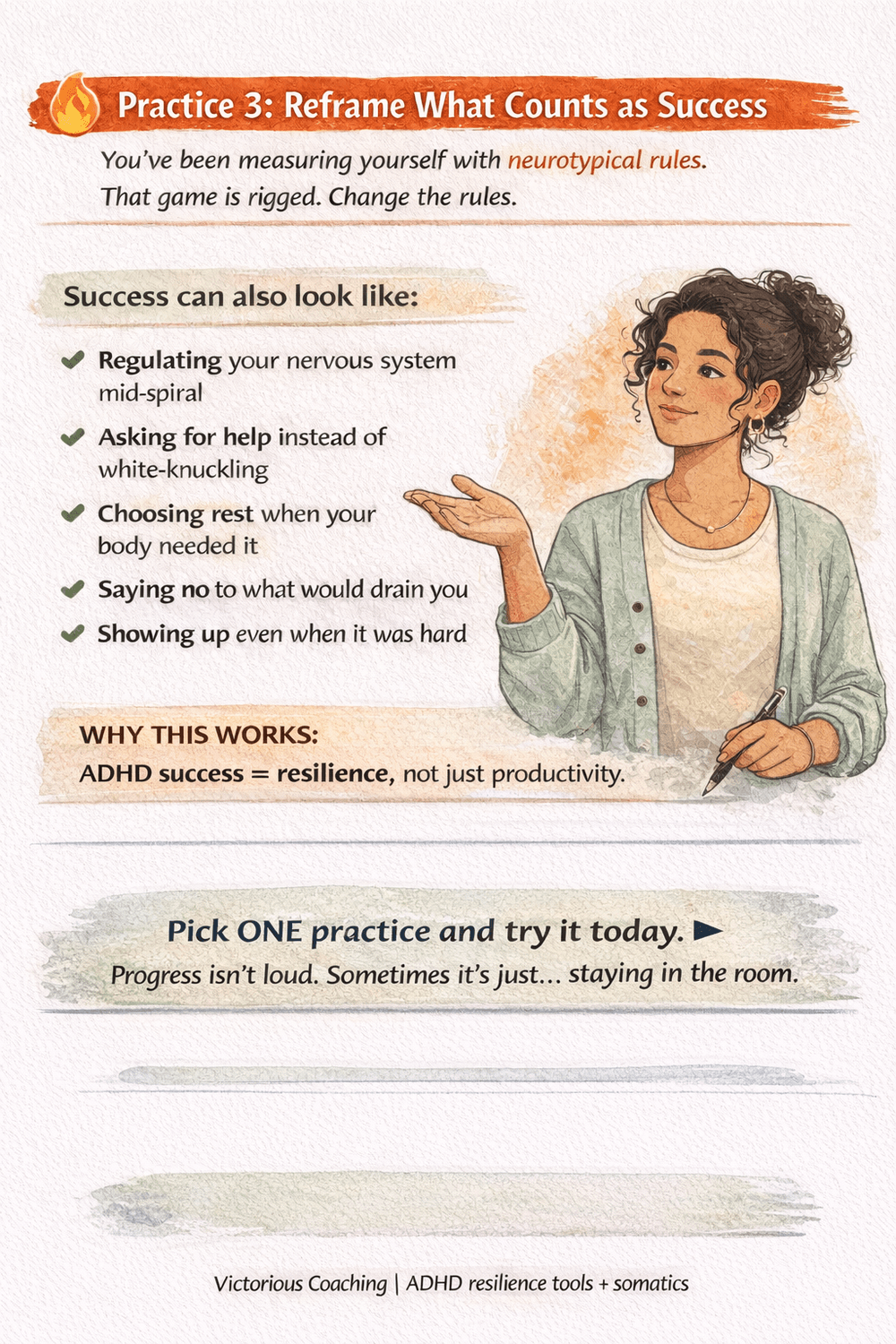
Success for an ADHD brain isn't just about what you accomplished. It's about:
Emotionally regulating when you started to spiral
Asking for help instead of white-knuckling
Choosing rest when your body needed it
Saying no to something that would have depleted you
Showing up even when it was hard
Those are wins. Those count.
If the only thing you did today was not abandon yourself, that's a success. Write it down.
If you paused and took three breaths instead of reacting from dysregulation, that's a success. Claim it.
Stop measuring yourself by a neurotypical yardstick. You're not neurotypical. You never will be. And that's not a problem.
Redefine what success means for YOUR brain, YOUR nervous system, YOUR life.
And then start noticing when you're actually succeeding by those standards.
Your Wins Count (Even When Your Brain Says They Don't)
Success amnesia is real. It's neurological. It's compounded by trauma and masking and a lifetime of trying to fit into systems that weren't designed for your brain.
But it's not permanent. You can rewire it.
Not by trying harder to remember. But by anchoring wins in your body. By creating external evidence. By redefining what success actually means for you.
Your brain might erase your accomplishments. But you don't have to participate in that anymore.
You did the thing. It counts. And you get to claim it.
Free Resources
P.S. If you're wondering about me - I hold a PCC coaching credential, breathwork facilitation certification, trauma sensitive somatic training, adhd certification, ongoing supervision, and about a decade of my own therapeutic and somatic work.
I'm also neurodivergent as hell, which informs everything about how I work. None of that makes me the right coach for you, but it hopefully gives you a sense of how I come to this work.
I may receive a commission for links shared in a blog, podcast, or newsletter. You don’t have to use these links, yet I’d be grateful if you chose to! Thanks again for your support, I hope you find the content supportive, insightful, and helpful!
Get on the newsletter 👇🏾
Take me to
Comments
Recent Posts
See All
T&C || Privacy Policy || Home || Quiz
Supporting women reclaim authorship of their lives by moving beyond labels, expectations, and inherited stories so they can live with greater agency, rhythm, and freedom


©2026 adventuresOFcommunity DBA Victorious Coaching
Adventurously based in Denver, CO