

Why Your ADHD Patterns Keep Coming Back (And What's Actually Underneath Them)
All of my writing is free. I write because it allows me to better understand my own points of view, I thoroughly enjoy it and I believe that knowledge gets to be accessible, not locked behind a pay wall. Yet, creating deep, quality content takes time, energy, and a herculean effort from this adhd brain. In the spirit of reciprocity, if something here lands for you, consider buying me a coffee to support this work 🙏🏾
Find out where you are on the adhd grief cycle right here.
The Real Reason ADHD Patterns Are So Persistent
If you are a late-diagnosed woman with ADHD and you have spent a significant amount of time trying to change a pattern that keeps showing back up anyway, this is not a personal failing. It's a structural problem with how most inner work approaches the question.
Most approaches work on the surface of the pattern. This one goes underneath.
There is a version of self-help advice that has been circulating long enough that most of us have tried it at least once.
Identify the pattern,
name the belief underneath it,
write the opposite somewhere you'll see it,
commit to new behavior.
And then, about two weeks later, usually right when your nervous system is under pressure, the pattern is back.
If this has been your experience, the explanation is not that you didn't try hard enough.
It's that you were working on the surface of something that has roots.
For late-diagnosed ADHD women specifically, a significant portion of our behavioral patterns aren't just regulation challenges. They're protective adaptations. They're the strategies we built when we were kids who had no framework for understanding that our brains worked differently, kids who just kept getting feedback that something about how we moved through the world was too much, not enough, or fundamentally off.
The pattern that looks like chronic avoidance might have been the only self-protective move available to a kid whose nervous system was overwhelmed in classrooms not built for her.
The pattern that looks like compulsive people-pleasing might have been the most rational risk management strategy for a child whose authentic emotional expression kept getting labeled as a problem.
The pattern that looks like self-sabotage might have been a little girl who learned that not trying fully made failing less humiliating.
These were not wrong conclusions. They were survival conclusions. And survival conclusions, unlike most things, do not come with expiration dates.
What ADHD Masking Actually Looks Like Underneath
Most conversations about ADHD masking stop at recognition.
I was masking in that meeting. I mask around my family.
The recognition is important, but it's still surface level.
The deeper question that rarely gets asked is: what story is the mask protecting?
Because unmasking ADHD isn't just about stopping the performance. It's about understanding what you believed about yourself that made the performance feel necessary. That belief, that story, is what is running the pattern. Change the behavior without addressing the belief, and the behavior will keep reverting, because the belief is still intact, still doing its job, still treating the old context as current.
This is what I call the de-masking story.
What Personification Has to Do With ADHD Inner Work
Here's a tool that sounds deceptively simple: personification. Giving human characteristics to something that isn't human.
You already do this. You name storms. You talk to your plants. Some of us (not naming names) have full conversations with the car 🙃. We personify because it makes things relatable, and more importantly, it makes things workable.
The same applies to internal patterns and the beliefs underneath them. When a protective belief is just a shapeless feeling, a low hum of I always do this or this is just how I am, you cannot get traction on it. When you can locate it in time, give it a form, and understand the specific logic it was built from, you are no longer fighting a fog. You are in conversation with a part of yourself that has been genuinely trying to keep you safe.
The Mossy Ground vs. the Canopy
The distinction I come back to in this work is the difference between standing on the mossy ground and getting up to the canopy.
The mossy ground is fully inside the experience. The weight is real. You can't see past the tree directly in front of you. The canopy gives you enough height to see the whole landscape. You don't leave yourself, you just gain perspective. And from that perspective, compassion is far more accessible than critique.
This is imperative for ADHD women doing inner work, because we tend to cycle into self-criticism when patterns persist. The canopy view interrupts that cycle. It replaces judgment with curiosity. And curiosity, not willpower, is where sustainable change actually comes from.
The Writing Practice: Step by Step
This is your actual exercise. Do it in whatever format your brain will cooperate with: handwritten journal, notes app, voice memo. What matters is that you get it out of your head.
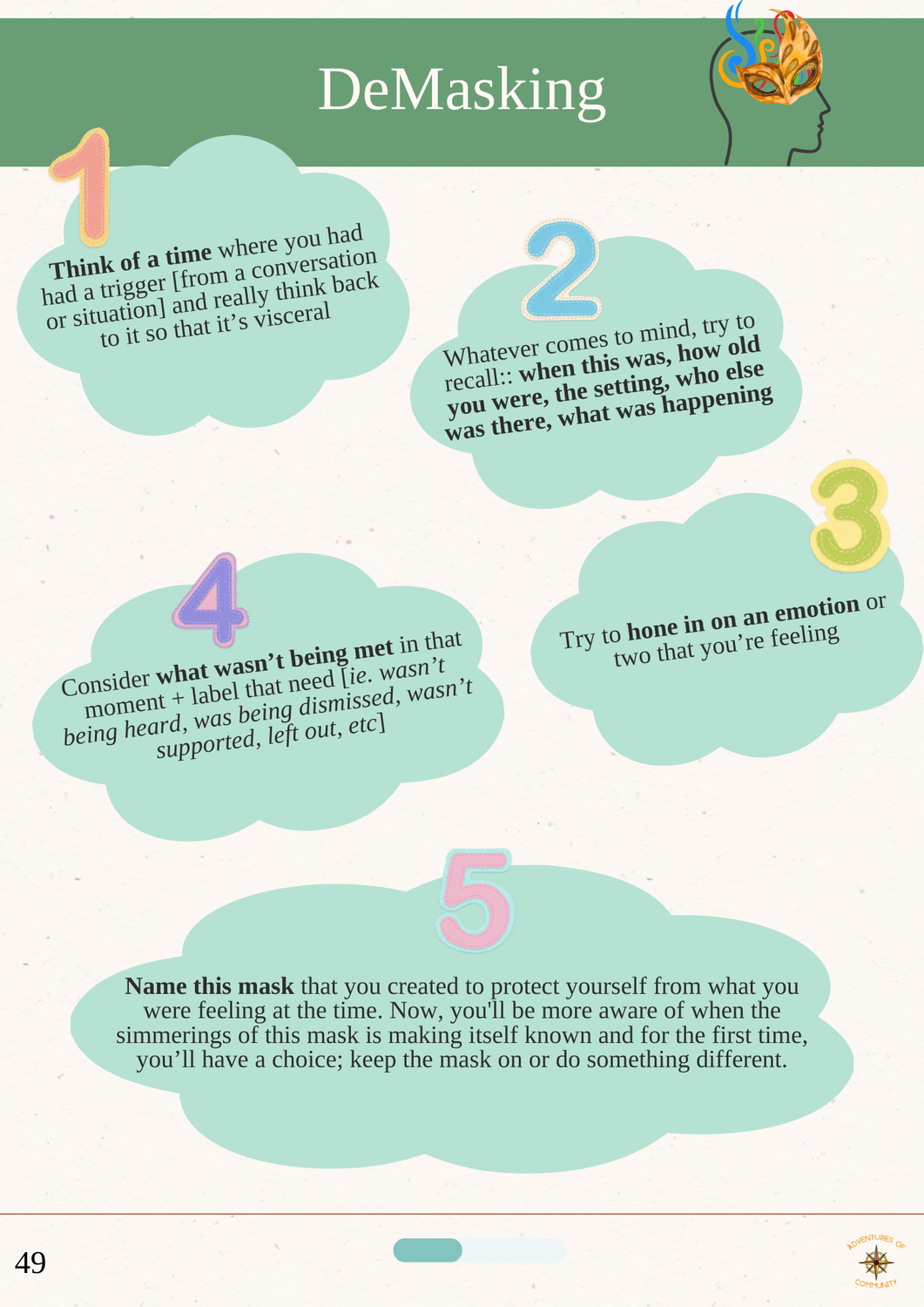
Step 1: Identify the story. Think about a belief you carry that doesn't feel like a belief, it feels like a fact. The kind that shows up right before you do something that matters.
Step 2: Locate it in time. Ask yourself how old you were when this story first formed. Not when you identified it intellectually. When it arrived as something that felt true, because something happened that made it feel necessary.
Step 3: Reconstruct the context. Sit with what was around you then. Who was in the room? What were the stakes? What did your body do? There may be sensory details attached: a smell, a sound, a physical sensation in your chest or stomach. Notice what's available without forcing anything.
Step 4: Write the story of your protection mask. What it formed around. What it was protecting you from. What it has cost you, and what it has given you in return.
Step 5: Give it a name. A real one. Not a dismissive one. This part of you has been on duty for years, running a protection strategy because she genuinely believed it was keeping you safe. She deserves a name and some dignity before you ask her to stand down.
Step 6: Sit with the gap. What did she need back then? What do you need now? Those two things are probably not the same. That gap is where the real work begins.
Why Compassionate Inquiry Works Better Than Reframing for ADHD
Forced reframing produces forced behavior. And forced behavior, as most late-diagnosed ADHD women know from long experience, collapses the moment the nervous system is actually under pressure.
Compassionate inquiry works differently. Instead of overwriting the belief with a counter-statement, you're going back to understand the conditions under which the belief formed. You're bringing the younger version of you who built it into enough light that she can see the situation has genuinely changed.
That is what makes change durable for neurodivergent women specifically. Not willpower applied against a pattern.
Understanding deep enough, that the old story becomes genuinely less interesting than what is actually true now.
Lorem ipsum dolor sit amet, consectetur adipisicing elit. Autem dolore, alias, numquam enim ab voluptate id quam harum ducimus cupiditate similique quisquam et deserunt, recusandae.
They overlap significantly. ADHD masking typically refers to the behavioral adaptations neurodivergent people develop to appear neurotypical in social contexts. A protection strategy is the belief system underneath the behavior. You can stop masking behaviorally and still carry the beliefs that made masking feel necessary. The de-masking story addresses both layers.
Inner child work for ADHD women often involves going back to the specific moments when protective beliefs were formed, usually during childhood or adolescence before diagnosis, to understand what those beliefs were responding to. The goal is not to re-experience difficult moments, but to bring enough compassionate perspective to them that the old strategies no longer have to run on autopilot.
No. This is self-coaching work, and it is not a substitute for professional mental health support. If you have a trauma history, it's worth doing this kind of exploration alongside a licensed therapist. The Victorious Coaching program is designed as a self-guided resilience practice, not clinical treatment.
Want to continue this work? The Victorious Coaching podcast is a free six-month self-coaching program for late-diagnosed neurodivergent women. Not sure where to start? [Take the Adventuring with ADHD quiz] to find out exactly where you are in your own cycle.
[ Want to start the free self coaching program? Here’s episode 1]
P.S. If you're wondering about me - I hold a PCC coaching credential, breathwork facilitation certification, trauma sensitive somatic training, adhd certification, ongoing supervision, and about a decade of my own therapeutic and somatic work.
I'm also neurodivergent as hell, which informs everything about how I work. None of that makes me the right coach for you, but it hopefully gives you a sense of how I come to this work.
I may receive a commission for links shared in a blog, podcast, or newsletter. You don’t have to use these links, yet I’d be grateful if you chose to! Thanks again for your support, I hope you find the content supportive, insightful, and helpful!
Get on the newsletter 👇🏾
Comments
Recent Posts
See All

T&C || Privacy Policy || Home || Community
Supporting women reclaim authorship of their lives by moving beyond labels, expectations, and inherited stories so they can live with greater agency, rhythm, and freedom


©2026 adventuresOFcommunity DBA Victorious Coaching
Adventurously based in Denver, CO