
The ADHD Industry Isn't Made for Women: Why \"Overcoming\" Your Brain Is Making Everything Worse
All of my writing is free. I write because it allows me to better understand my own points of view, I thoroughly enjoy it and I believe that knowledge gets to be accessible, not locked behind a pay wall. Yet, creating deep, quality content takes time, energy, and a herculean effort from this adhd brain. In the spirit of reciprocity, if something here lands for you, consider buying me a coffee to support this work 🙏🏾
The Language of "Overcoming" Is the Language of Shame
Let me start with something that needs to be said: the ADHD industry is not built for you.
It wasn't designed with your body in mind, your hormonal cycles, your socialization, or your lived reality. And those strategies, hacks, and productivity systems you've been beating yourself up for not maintaining? They were literally based on research conducted on prepubescent to adolescent boys, predominantly white, with little to no ethnic, sex, or comorbid diversity in study populations.
Not adults. Certainly not women who have spent decades masking, people-pleasing, and contorting themselves into acceptable shapes just to survive in spaces that were never designed for them.
The Research Gap Is Actually a Canyon
Here's the uncomfortable truth that most ADHD content skips over: the research has been fundamentally biased from the beginning!
A 2020 scientific review published in the journal of women’s mental health analyzed decades of ADHD research and found that between 1979 and 2020, the male-to-female ratio in participant samples averaged 3 to 1, with some studies going as high as 9 to 1. We're talking about decades of scientific literature built almost entirely on how ADHD presents in boys and men. [Citation]
Until recently, the diagnostic criteria in the DSM were developed based primarily on research with hyperactive boys in school settings. The inattentive presentation, the way ADHD most commonly shows up in women, wasn't officially recognized until 1987. And it remains dramatically under-diagnosed in female populations.
Let that sink in: the criteria used to diagnose you were designed to catch disruptive boys in classrooms, not women experiencing internal chaos while appearing externally composed.
So when you're a 35-year-old woman trying to figure out why the strategies from that viral ADHD influencer aren't working, it's not because you're broken or not trying hard enough. It's because those strategies were never designed for a body that menstruates, experiences perimenopause, or has spent 30 years developing sophisticated masking behaviors just to survive in neurotypical spaces.
For more about the hormones of it all, I recommend following Dr Jolene Brighten.
What Gets Studied vs. What Gets Ignored
The research loves to focus on hyperactivity, impulsivity, and external behavioral symptoms; the things that disrupt classrooms and workplaces.
What doesn't get studied nearly enough?
The internal experience.
The emotional dysregulation.
The rejection sensitivity that feels like physical pain.
Studies have found that women with ADHD experience significantly higher rates of emotional dysregulation and rejection sensitivity than men, but these symptoms aren't even part of the diagnostic criteria. We're being diagnosed based on criteria that literally exclude some of our most debilitating symptoms. Citation.
The [Missed] Hormone Factor
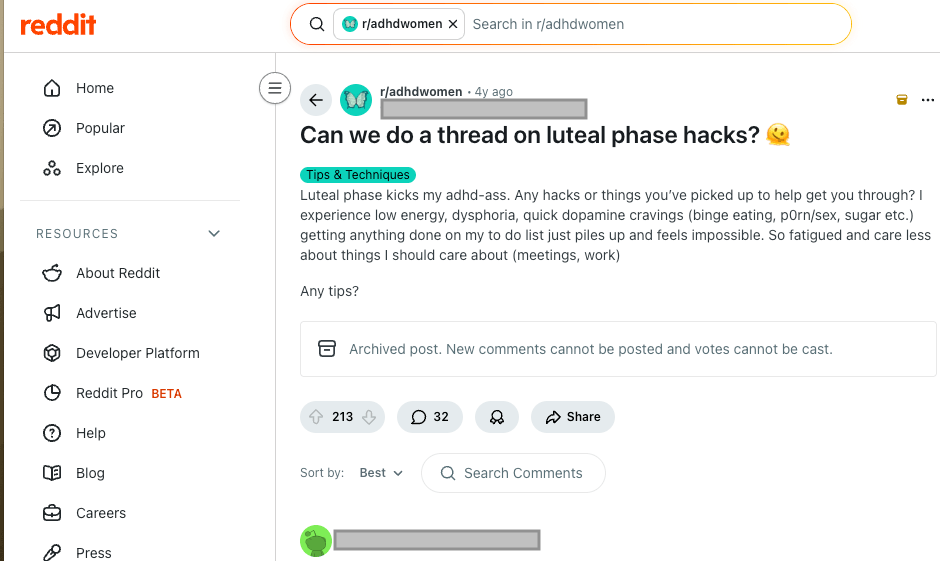
Here's something that may make you furious: multiple studies published in journals have shown that hormonal fluctuations across the menstrual cycle significantly impact ADHD symptom severity in women. Estrogen affects dopamine regulation, which means your ADHD symptoms can vary wildly depending on where you are in your cycle. Here’s one example.
But how many of your doctors asked about your cycle when diagnosing or treating you?
How many ADHD resources even mention this connection?
The relationship between estrogen and dopamine is direct: when estrogen is low (during certain phases of your menstrual cycle, perimenopause, and menopause), dopamine transmission decreases, and ADHD symptoms intensify. Conversely, when estrogen is high, dopamine transmission improves, and symptoms may be more manageable.
This isn't an oversight. It's a feature of a medical system that has historically treated male bodies as the default and female bodies as confusing variations that complicate the data.
The Language of Shame
Now let's talk about this word that's everywhere in ADHD content: overcome.
Overcome your ADHD.
Overcome your executive dysfunction.
Overcome your time blindness.
What we're really saying when we use this language is that there's something fundamentally wrong with you that needs to be conquered, defeated, transcended. Let’s be real: it’s ableism dressed up in productivity language.
You don't overcome the way your brain is wired. You don't overcome your neurological makeup. That's not empowerment.
And here's what makes this particularly insidious for women: we've already spent our entire lives trying to overcome something.
Overcome being too emotional.
Overcome being too sensitive.
Overcome not being likable enough, agreeable enough, small enough, quiet enough.
And now we're being sold the same shame spiral with a neurodivergent label slapped on it.
The ADHD industry loves to sell the fantasy that if you just find the right planner, the right morning routine, the right supplement stack, the right body doubling app, you'll finally be able to function like a neurotypical person. And when those things inevitably don't work, not necessarily because they can't work, but because they're not designed for your actual nervous system. And thus, you blame yourself.
You think you're the problem. You think you're not disciplined enough, not committed enough, not trying hard enough.
But what if the problem isn't you?!!!
What if the problem is that we're using a deficiency model to understand something that isn't a deficiency at all?
ADHD isn't a bug in your system that needs to be patched. It's your actual operating system. And trying to override your operating system 24/7 is what's creating the burnout, not the ADHD itself. 🤯
What If We Adventured Instead?
So if we're not trying to overcome ADHD, what are we doing?
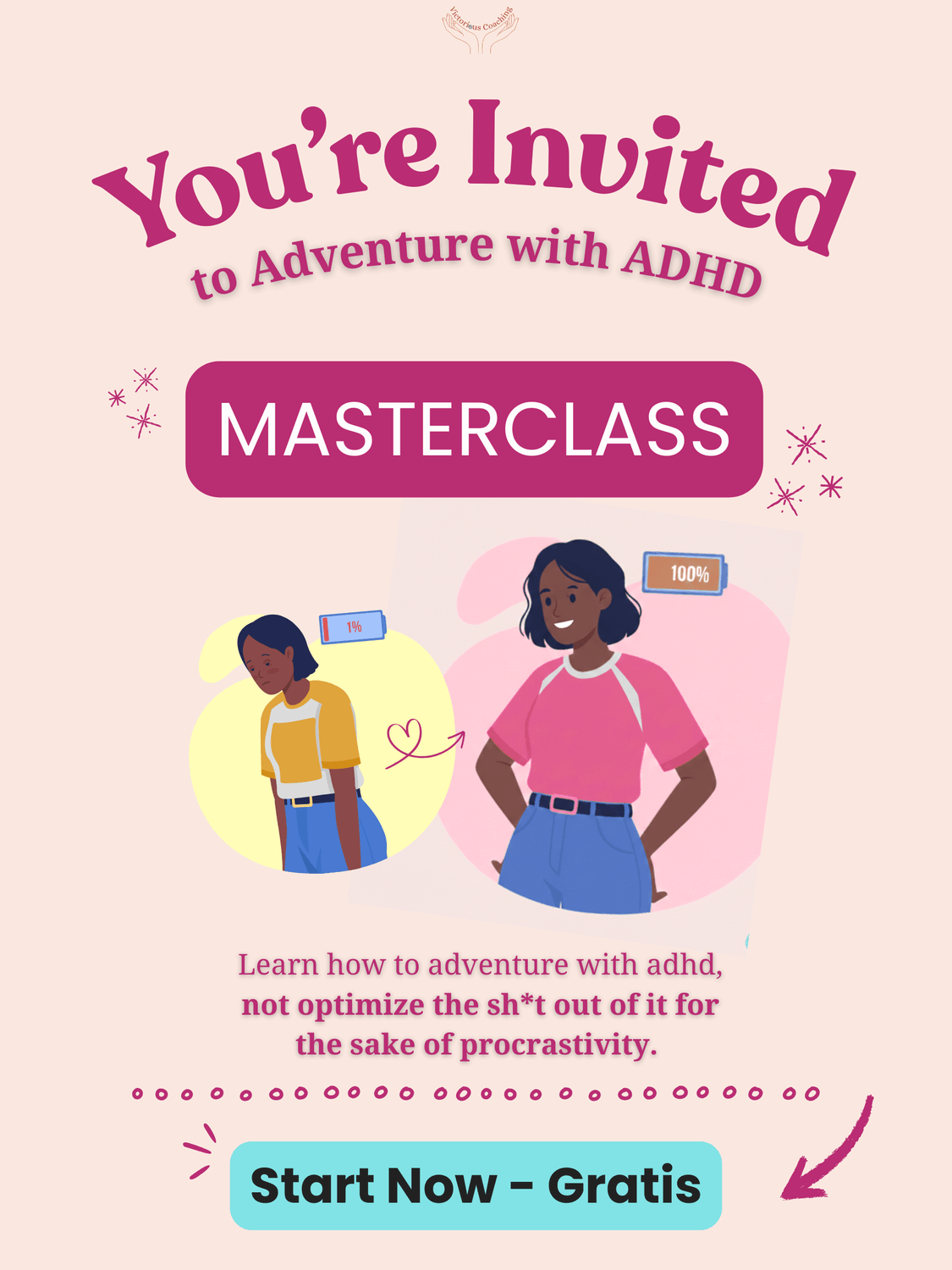
We're learning to adventure with it.
Adventuring with ADHD means getting genuinely curious about how it expresses through YOUR body, not how the research says it should present. It means paying attention to your own patterns instead of trying to force yourself into someone else's system.
It means asking questions like:
What ADHD symptoms amplify in my body when I'm dysregulated versus when I'm in flow?
How does my focus change throughout my menstrual cycle?
What environments genuinely support my nervous system versus which ones I've been told should work?
What does rest actually look like for my brain, not the Instagram version of rest?
What's worked for me before (like gamification on an app) and how can I creatively translate that tendency to different areas of my life?
This is where the embodied piece becomes non-negotiable. You cannot adventure with something you're dissociated from. You cannot learn to work with your nervous system if you're constantly trying to override it, push through it, or pretend it doesn't exist.
Acceptance Is Not Resignation
Acceptance isn't resignation. Accepting that you have ADHD, accepting how it shows up in your body, accepting that you need different strategies, that's not giving up. That's the beginning of actual agency.
Research on Acceptance and Commitment Therapy (ACT) for ADHD has shown that psychological flexibility and acceptance-based approaches led to significant improvements in ADHD-related impairment and quality of life, even without changes in core ADHD symptoms. Translation: accepting your ADHD actually helps you function better than fighting it does. Citation.
When you stop fighting against your own neurology, you free up all that energy you were using to mask and perform and pretend. And you can redirect it toward building a life that actually works for your nervous system instead of constantly trying to make yourself small enough to fit into systems designed for someone else's brain.
This is what I mean by embodied autonomy: not autonomy from ADHD, but autonomy to make choices that honor how you're actually wired. Autonomy to say no to strategies that harm you even if they work for other people. Autonomy to design your own metrics for success instead of measuring yourself against neurotypical productivity standards.
The Industry That Profits From Your Self-Doubt
The entire industry that profits from you believing you're broken? ADHD.
Every app subscription, every course, every productivity system, every ADHD life hack you buy is predicated on the idea that you need to be fixed. And if you actually arrived at a place of acceptance and embodied autonomy? You might stop buying so many ‘bandaids’.
I'm not saying all ADHD resources are predatory. But I am saying we need to get a lot more critical about who's creating content, what their credentials are, and whether their advice is actually rooted in understanding neurodivergent nervous systems or just repackaging neurotypical productivity advice with ADHD keywords for the algorithm.
Because here's what's happened: coaching is a relatively unregulated industry, people can take weekend certification programs, and suddenly everyone's an ADHD expert selling you their proven five-step system to finally get your life together. And when their system doesn't work, you think it's your fault.
No. Just, no.
The Real Work Isn't Sexy
The actual work of living with ADHD isn't sexy. It's not a before-and-after photo. It's learning to track your own nervous system responses and measuring your progress in the noticings. It's building self-trust after decades of being told you're too much or not enough. It's grieving the life you thought you'd have and making space for the life your nervous system can actually sustain.
That doesn't fit in a carousel post. That doesn't go viral. But it's the real work.
The ADHD industry isn't built for you. The research wasn't done on bodies like yours. The strategies you're failing at weren't designed for your nervous system. And the science backs this up in study after study.
You don't need to overcome anything. You get to be curious. You get to adventure. You get to build a relationship with your brain that's based on knowledge, acceptance, and embodied autonomy — not shame and optimization.
ADHD can be an adventure, not a jail sentence. But that starts with refusing to participate in systems that profit from your self-hatred.
P.S. If you're wondering about me - I hold a PCC coaching credential, breathwork facilitation certification, trauma sensitive somatic training, adhd certification, ongoing supervision, and about a decade of my own therapeutic and somatic work.
I'm also neurodivergent as hell, which informs everything about how I work. None of that makes me the right coach for you, but it hopefully gives you a sense of how I come to this work.
I may receive a commission for links shared in a blog, podcast, or newsletter. You don’t have to use these links, yet I’d be grateful if you chose to! Thanks again for your support, I hope you find the content supportive, insightful, and helpful!
Get on the newsletter 👇🏾
Take me to
Comments
Recent Posts
See All

T&C || Privacy Policy || Home || Quiz
Supporting women reclaim authorship of their lives by moving beyond labels, expectations, and inherited stories so they can live with greater agency, rhythm, and freedom


©2026 adventuresOFcommunity DBA Victorious Coaching
Adventurously based in Denver, CO