

Window of Tolerance: Why You Go From Fine to Not Fine So Fast
All of my writing is free. I write because it allows me to better understand my own points of view, I thoroughly enjoy it and I believe that knowledge gets to be accessible, not locked behind a pay wall. Yet, creating deep, quality content takes time, energy, and a herculean effort from this adhd brain. In the spirit of reciprocity, if something here lands for you, consider buying me a coffee to support this work 🙏🏾
Find out where you are on the adhd grief cycle right here.
Window of Tolerance: Why You Go From Fine to Not Fine So Fast
Picture this.
It's a regular degular Tuesday. Nothing dramatic has happened. You've managed your morning, gotten through your emails, you're doing ya thing.
And then someone uses a tone with you.
Or a plan changes last minute.
Or you get a text that reads as slightly off yet you don't know quite why.
And something in you just... tips.
Not gradually. Not with any warning. One moment you're fine and the next you're either completely flooded, heart racing, can't think straight, saying things you'll have to apologize for later, or you've completely checked out. Blank. Gone. Sitting inside your own body like a passenger who's lost the wheel.
And the thing that tipped you wasn't even that big!!
But it felt enormous. And you don't know why it always feels enormous.
If this sounds familiar, you're not broken. You're not too sensitive. You're not a failure at managing your emotions.
You’ve got a compressed window of tolerance.
What Is the Window of Tolerance?
The window of tolerance is a concept that was developed by Dr. Dan Siegel in 1999 and later expanded by researchers like Dr. Stephen Porges and Dr. Peter Levine.
It sounds clinical. The concept itself is beautifully, practically simple.
Think of it like an accordion. I do.
When the accordion is fully open, you have range. You have flexibility. You can move with whatever life brings without immediately hitting a wall. You can feel big emotions and still function. You can handle stress and still think clearly. You can be in conflict and still access your rational brain.
That open accordion is your window of tolerance.
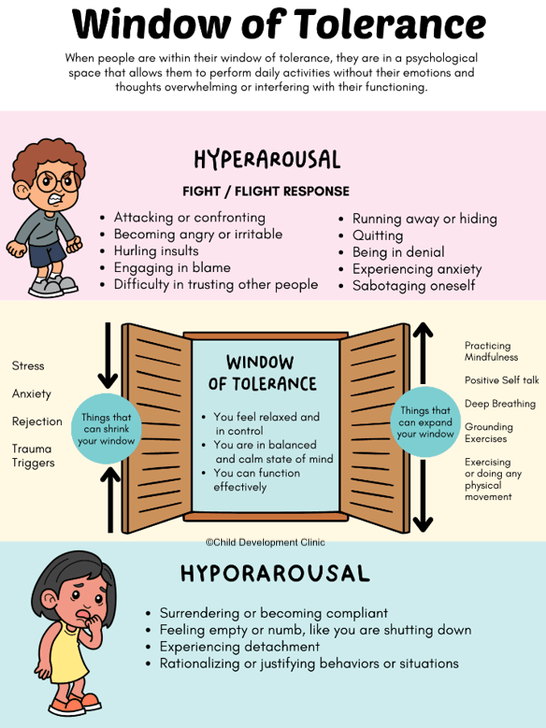
The space inside it is where you can think, feel, respond, and function all at the same time. This is the zone where actual living happens. Where you make good decisions. Where you feel your feelings without becoming them. Where you can be present in your own life.
Now here's what happens when that accordion gets compressed.
The range shrinks. The flexibility disappears. Now even small things push you out of that narrow window fast.
And when you go out of it, you go one of two directions.
The Two States Outside Your Window
Hyperarousal: The Flooded State
This is the activated, overwhelmed end of the spectrum. Also known as the fight or flight response.
Anxiety cranked to eleven. Racing thoughts. Irritability. Reactivity. Your heart pounding. Your skin feeling too tight for your body. Snapping at someone you love over something minor. Spiraling into a rumination loop from a single text message.
You might say things you don't mean. You might make decisions you'll regret. You might feel like you're vibrating out of your own skin.
This is hyperarousal. Your nervous system has hit the panic button and flooded your system with activation.
Hypoarousal: The Shutdown State
This is the opposite end. The collapse. The freeze response. Also known as, dorsal vagal.
Can't get off the couch. Brain fog so thick you can't complete a sentence. Dissociation. Emotional numbness. Lying on the floor feeling like a pile of laundry waiting to be folded. The lights are on but nobody's home.
This is your nervous system hitting the emergency brake. It's the shutdown that happens when fight or flight isn't an option.
The Ping-Pong Pattern
And for many of us, especially late-diagnosed ADHD women, we ping-pong between the two.
Activated and then crashed.
Flooded and then frozen.
Rarely, if ever, hanging out in that middle space where actual living happens.
I used to be able to go from completely fine to fully activated by a tone of voice. Not even unkind words. Just a tone. And two hours later when I'd come back down I'd look at what triggered it and think: that was nothing. Why did that feel like everything?
The answer was that my accordion was so compressed there was almost no room to move before I hit an edge.
Why ADHD Specifically Shrinks Your Window
So why do ADHD brains tend to have a narrower window of tolerance than neurotypical brains?
A few reasons that layer on top of each other.
1. Emotional Dysregulation Is a Core ADHD Feature
This is still underrepresented when ADHD gets diagnosed as well as public discussions on the top. We talk about attention, hyperactivity, impulsivity.
But emotional dysregulation, the inability to modulate the intensity and duration of emotional responses, is one of the most consistent and impactful features of the whole experience.
ADHD brains feel things more intensely and take longer to return to baseline after an emotional event.
The window starts narrower because the nervous system is working with less natural regulation capacity from the beginning.
This is not a personal failing. This is how the brain is wired.
2. A Lifetime of Being Told You Were Too Much
If you're a late-diagnosed ADHD woman you've probably spent decades being told, directly or indirectly, that your reactions were too big.
Too sensitive. Too dramatic. Too emotional.
So what did you do? You learned to manage. To contain. To perform regulation you didn't actually have. To white-knuckle your way through situations that were genuinely overwhelming and tell everyone including yourself that you were fine. TO MASK.
I did this for years. I am exceptional at performing fine. I had absolutely no idea that performance had a cost until my body started presenting the bill.
Chronic suppression of the nervous system's natural responses keeps it in a low-level state of activation constantly.
Like a pot that's always simmering. It takes very little to tip it over.
3. The Cumulative Load
We talked in last week's episode about how gut health, hormones, inflammation, and stress all impact the nervous system. All of that is load on your window.
Imbalanced gut [dysbiosis]: adds load
Hormonal fluctuations: adds load
Chronic inflammation: adds load
Unprocessed emotional experiences: adds load
Decades of masking: adds load
The window doesn't shrink overnight. It compresses gradually under the weight of everything your nervous system has been managing without the tools to process and release it.
The result:
A nervous system that is chronically closer to its edges than its center. Easily tipped into hyperarousal or hypoarousal by things that seem small from the outside but feel enormous from the inside.
To a compressed accordion, most things are enormous.
What Regulation Actually Means
Let's clear something up because I think regulation gets misunderstood in almost every wellness space. 🙃
Regulation is NOT:
Being calm all the time
Not feeling big emotions
Having no reactions
Being unbothered
Performing okayness
Been there. Done all of those. None of them are regulation. And honestly, none of them help long term.
Regulation IS the ability to move through your emotional and physiological states without getting stuck at the extremes.
It's FEELING angry and not staying flooded for three days.
It's FEELING anxious and being able to bring yourself back without it spiraling into a full shutdown.
It's BEING in conflict and staying in your body instead of either exploding or completely checking out.
I think about the NOW version of me that can be in a disagreement with my husband and stay present in my body, curious instead of catastrophizing.
That absolutely did not used to be possible for me, even two years ago. The accordion was too compressed. Any conflict hit an edge immediately. I’d stonewall, get choked up, go mentally blank, feel stupid and so I’d leave. Go on a walk alone at 10pm or start racing through Skyscanner to find affordable flights to anywhere but here.
Now there's room. Not infinite room. But actual, real, spacious room.
The aim is not stillness. The aim is range.
A regulated nervous system is one where the accordion can open wide and come back to center. It can expand into big experiences and return to baseline. It moves. It's flexible. It has capacity.
An unregulated nervous system is one where the accordion is stuck. Jammed open in hyperarousal or collapsed shut in hypoarousal.
The Good News: Neuroplasticity Is Real
HEAR ME!!!!
This is unlearnable. Neuroplasticity in action!
Your nervous system is not fixed. It is not permanent. The patterns that developed over decades of inadequate support can be interrupted, rewired, and replaced with new ones!! WHAT A THRILL!
Not quickly though. Not without practice. But genuinely, actually, biologically possible.
The neuroscience on this is solid. The brain maintains the capacity to form new neural pathways throughout your lifetime. What gets practiced gets wired. What gets wired becomes the new pattern.
My own cortisol is down. My sleep is deep. My accordion has actual range now. I can be in conflict without catastrophizing. I can handle stress without immediately shutting down or flying off the handle.
That is not a personality change. That is a nervous system that has been consistently given what it needed over time.
Yours can do the same.

What Expanding Your Window Actually Requires
So what does it take to expand your window of tolerance?
I want to be honest with you here because wellness content tends to skip this part too.
1. Consistency Over Intensity
One breathwork session or one really good therapy appointment nor that one week of 2 mother aya sessions - these don’t typically expand your window forreal.
What expands it is micro, regular, repeated inputs to your nervous system that gradually teach it a new baseline.
Consistent therapy with integration between sessions.
Mother aya sessions with, shocker, continued integration for months afterward.
Consistent breath sessions, coupled with practicing breathwork at home.
Think of it like physical therapy after an injury. You don't do one session and walk out healed. You do the exercises every day, even when they feel boring or small, until the tissue actually rebuilds.
If you don’t, well ask to see my non moveable left-big-toe. As I chose NOT to do my physical therapy after bunion surgery a decade ago🙃. For my toes, it’s too late. For your mind, it ain’t.
I spent months doing small practices daily before I noticed the accordion had more room. Months. Not a weekend retreat. Months of boring, unglamorous, consistent small inputs.
It was worth every single one.
2. Going Slow to Go Far
One of the counterintuitive things about nervous system work is that pushing harder makes it worse.
Forcing yourself through activation without support actually reinforces the dysregulation. The window expands when you work at its edges gently, not when you blast through them. Straight perseverance, in this case, definitely ain’t it.
3. Body-Based Work, Not Just Cognitive Work
This is the big one and I feel strongly about this.
You cannot think your way to a regulated nervous system.
I tried. I am a person who loves to understand things. I read everything. I analyzed my patterns. I’m a glutton for feedback so I can better understand my under the surface layering. I understood intellectually exactly what was happening in my nervous system.
Still dysregulated.
Because the window of tolerance lives in the body. It is a physiological state, not a mindset. Which means talking about it, analyzing it, and understanding it intellectually, while genuinely helpful for context, is not the same as actually shifting it.
You have to work with the body. Breath. Movement. Sensation. Posture. That is where the change actually happens.
Which is exactly why next week's episode is entirely practical. Ten embodied regulation tools for your resilience toolkit. When to use each one and why. All of them designed for ADHD brains and all of them accessible anywhere, anytime, including when you're already activated.
4. Patience With the Timeline
Real expansion takes months of consistent practice. Not days. Not weeks.
Honestly, maybe years 👀
But here's the good news: you feel early shifts before the full expansion happens.
More space between trigger and response. Less time spent in the extremes. Faster return to baseline after activation.
Those early shifts are evidence the work is working. Keep going.
What This Means For Your Life
Your window of tolerance is not your personality.
The reactivity, the shutdowns, the zero to flooded in sixty seconds, these are not who you are. They are the current capacity of a nervous system that has been carrying too much for too long without the right tools.
The Tuesday afternoon that tips you over a minor tone of voice is not evidence that you're broken. It's evidence that your accordion needs room.
And here's the most important thing:
The goal is not to feel less. The goal is to be able to feel more without losing yourself in it.
That's the window expanding. That is what this entire 6-month journey is building toward!!
A nervous system with enough range that you can handle the full spectrum of being human without immediately hitting your edges.
Where conflict doesn't feel like the end of the world.
Where disappointment doesn't send you into a three-day spiral.
Where stress is manageable instead of catastrophic.
That's not a fantasy. That's what a regulated nervous system with an expanded window of tolerance actually looks like in practice.
And it's available to you.
Resources for Going Deeper
If you want to learn more about the window of tolerance and polyvagal theory, here are five solid resources across different formats:
Books:
Video:
Podcast:
Other:
RELATED POSTS:
P.S. If you're wondering about me - I hold a PCC coaching credential, breathwork facilitation certification, trauma sensitive somatic training, adhd certification, ongoing supervision, and about a decade of my own therapeutic and somatic work.
I'm also neurodivergent as hell, which informs everything about how I work. None of that makes me the right coach for you, but it hopefully gives you a sense of how I come to this work.
I may receive a commission for links shared in a blog, podcast, or newsletter. You don’t have to use these links, yet I’d be grateful if you chose to! Thanks again for your support, I hope you find the content supportive, insightful, and helpful!
Get on the newsletter 👇🏾
Comments
Recent Posts
See All

T&C || Privacy Policy || Home || Community
Supporting women reclaim authorship of their lives by moving beyond labels, expectations, and inherited stories so they can live with greater agency, rhythm, and freedom


©2026 adventuresOFcommunity DBA Victorious Coaching
Adventurously based in Denver, CO